Emergency basement flood cleanup after sump pump failure, check availability in your area ☎ Call (877) 919-1672
Sump Pump Flood Cleanup Service

Basement Structural Drying After Sump Pump Flooding

Once the standing water is gone, the real work begins: drying the structure itself. Structural drying after a sump pump failure uses air movers and commercial dehumidifiers to pull moisture out of framing, subfloor, concrete and drywall, and daily monitoring to prove it is actually dry, not just dry to the touch. This is the phase that decides whether your basement recovers cleanly or grows mold behind a freshly painted wall two months later.

Why Air Alone Doesn't Dry a Flooded Basement

Opening a window and running a household fan dries the surface and leaves the moisture trapped inside the materials. Sump pump flood structural drying targets the structure itself, the water held in subfloor, wall cavities, concrete and framing, by combining three forces that work together: airflow to lift moisture off surfaces, dehumidification to remove it from the air before it re-absorbs, and temperature and humidity control to keep the whole process moving in the right direction.

Get the balance wrong and drying stalls. Too much evaporation without enough dehumidification simply moves moisture from the floor into the air and then into dry drywall across the room, spreading the damage. That is why structural drying is engineered, not improvised.
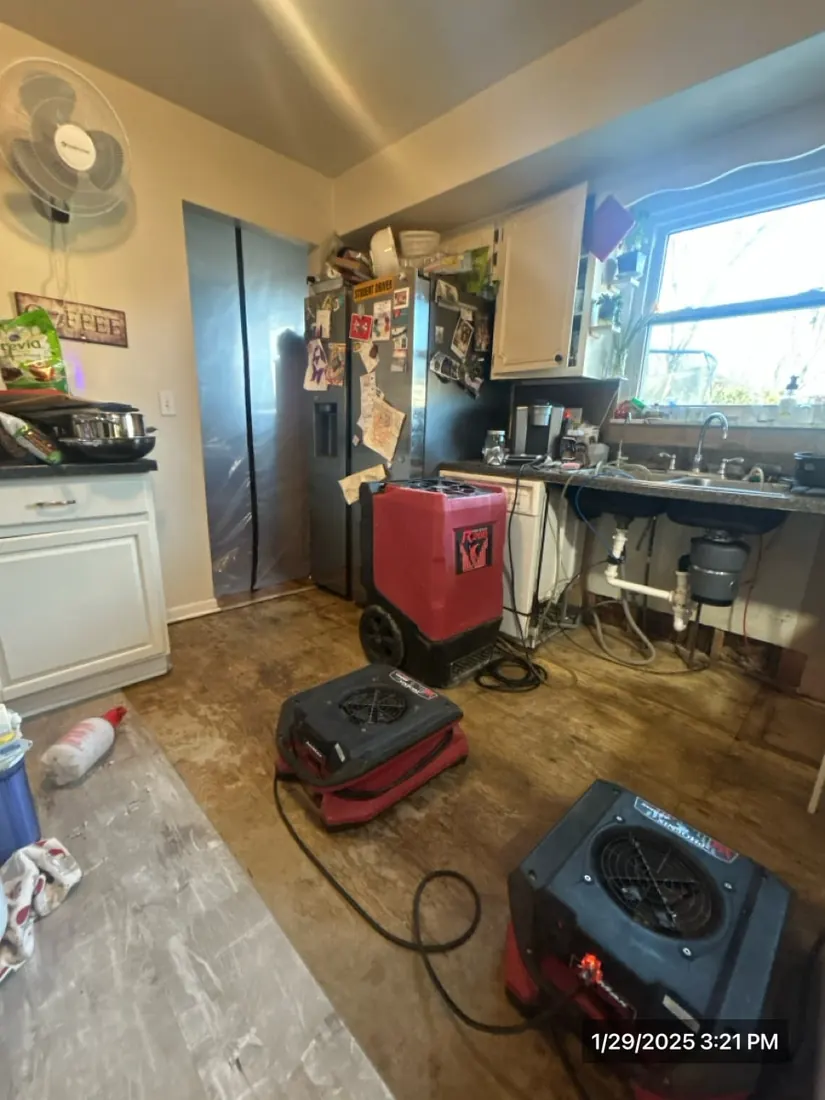
Commercial LGR dehumidifier set up for basement structural drying after sump pump flooding
A low-grain refrigerant dehumidifier pulls moisture out of the air so wet materials keep releasing water instead of re-absorbing it.

Signs Your Basement Needs Professional Drying

The Structural Drying Process, Step by Step

  1. Assess and map. Moisture readings establish which materials are wet and how wet, creating a baseline.
  2. Calculate the system. The affected area and conditions determine how many air movers and dehumidifiers are needed and where they go.
  3. Create airflow. Air movers are positioned to sweep air across every wet surface, including behind baseboards and into cavities where possible.
  4. Dehumidify. LGR dehumidifiers strip the moisture out of the air so materials keep releasing water instead of re-absorbing it.
  5. Monitor daily. Readings at fixed points, logged against a dry standard, show the trend and catch any material that is not drying.
  6. Verify and demobilize. Equipment comes out only when materials reach target readings, not on a fixed calendar date.

What Gets Dried, and the Psychrometrics Behind It

Drying a basement means drying everything the water reached, not just the open floor:

Professionals track psychrometrics, the relationship between temperature, relative humidity and the moisture the air can hold. By managing those variables, a drying chamber keeps the air hungry for moisture so wet materials keep giving it up. It is the science that separates engineered drying from a few fans and an open door.
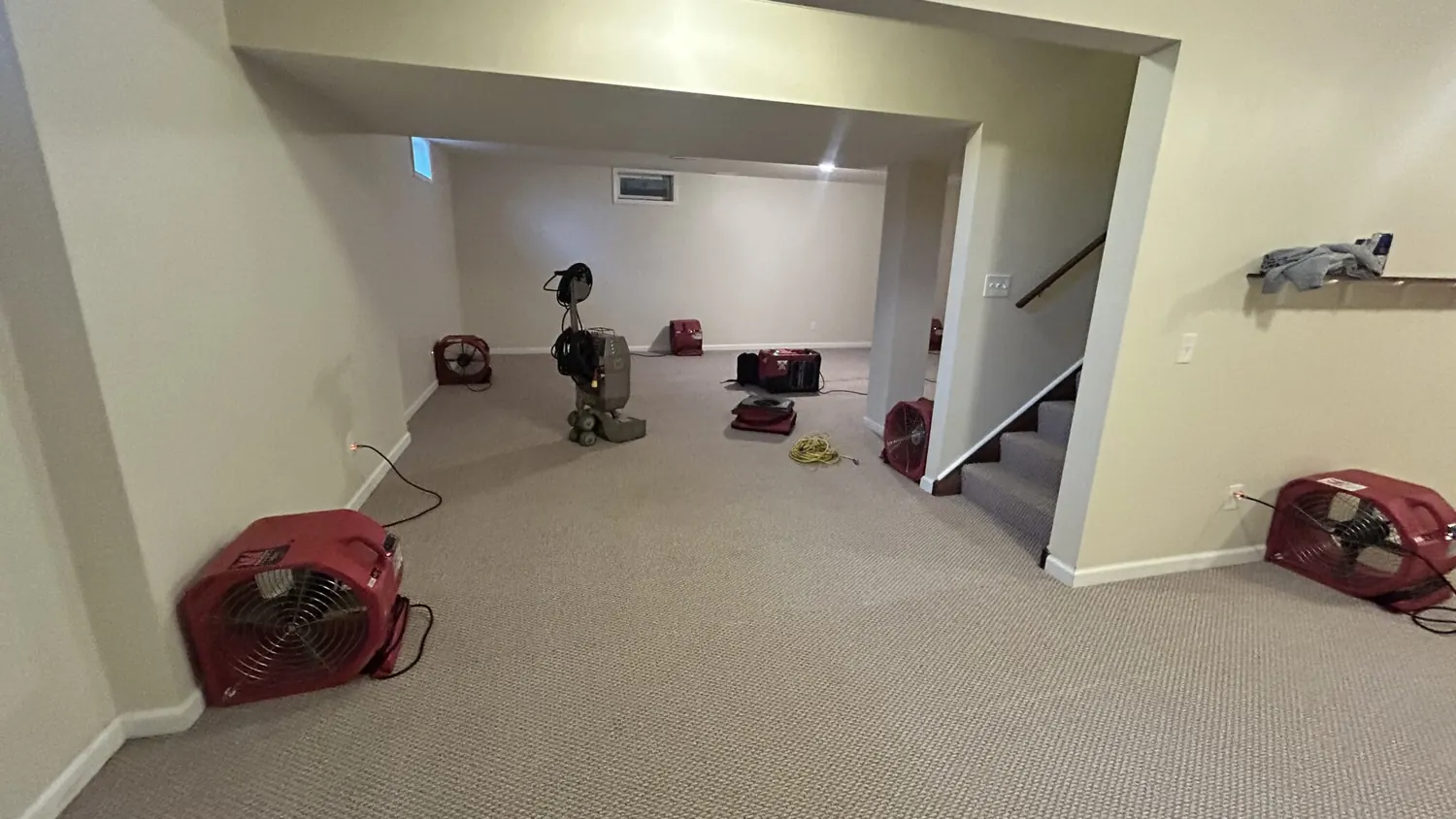
Air movers positioned across a basement floor during structural drying
Air movers create the airflow that lifts moisture off surfaces; placement and count are calculated from the affected area, not guessed.

How Drying Progress Is Measured

Drying is not finished when the floor feels dry; it is finished when materials reach a documented dry standard, typically the moisture level of unaffected materials of the same type elsewhere in the home. We take readings at the same points each day and log them, so you can see the trend and know when target levels are met. If a material is not drying, that is a signal to investigate trapped water rather than keep running equipment blindly. This verification links directly to moisture detection.

How long does structural drying take? There is no fixed timeline. Saturation, humidity, material type and airflow all matter. Many jobs run several days; a heavily saturated finished basement can take longer. Daily readings, not a calendar, decide when it is done.

An Illustrative Drying Job

Consider an unfinished-to-partly-finished basement after a pump failure left an inch of clean water standing overnight. After extraction, readings show the concrete slab and the bottom foot of drywall are well above a dry standard, and the stud bases are wet. A drying system of several air movers and one LGR dehumidifier is set, baseboards are pulled to let the wall bases breathe, and daily readings are logged. The slab, as concrete does, reads stubborn for the first couple of days and then falls into line. Equipment comes out only once the framing, slab and drywall all hit target. This is a representative illustration of the process, not a specific completed project.

How Drying Fits the Rest of the Cleanup

Drying sits between extraction and reconstruction. It overlaps with subfloor drying and wall cavity drying for the hard-to-reach moisture, and nothing should be rebuilt until drying is verified. The rebuild itself is flood damage restoration.

Frequently Asked Questions

What's the difference between water extraction and structural drying?
Extraction removes the bulk standing water you can see. Structural drying removes the moisture that soaked into materials and assemblies afterward. A flooded basement almost always needs both, extraction first, then monitored drying over several days.
Why are dehumidifiers and air movers left running for days?
Because structural materials release moisture slowly. The equipment has to run continuously to keep pulling moisture out of framing, subfloor and concrete, and out of the air before it re-absorbs. Those days of runtime are what actually prevent mold and warping, which is why they appear on an itemized estimate.
Is professional drying really better than renting a dehumidifier?
For a small, isolated, clean spill a rental may be enough. For real flooding, the value is not the machine; it is assessing which materials are wet, sizing and placing the equipment correctly, and verifying the structure reaches a dry standard. That verification is what prevents a second, bigger problem later.
How do you know when the basement is actually dry?
With daily moisture readings compared against a dry standard, documented in a log. When the affected materials reach target levels, drying is complete. Surface feel and the absence of a smell are not reliable indicators on their own.
Can drying spread the damage if done wrong?
Yes. Too much airflow without enough dehumidification can move moisture into the air and then into previously dry materials across the room. Balanced, engineered drying is what prevents that, which is a reason improvised fan-only drying can backfire on a real flood.
What is an LGR dehumidifier?
A low-grain refrigerant dehumidifier is a commercial unit that can pull moisture from air that is already fairly dry, reaching the low humidity levels needed to dry structural materials. It is far more capable than a household dehumidifier for flood drying.

Basement Flooded After a Sump Pump Failure?

Tell us your city, water depth, and whether water is still coming in. We'll walk you through safe next steps and check cleanup availability in your area.

☎ (877) 919-1672 Request Basement Flood Cleanup
